


"Manganese is the element of life". - Carey Reams
Why is it the element of life I wondered so many times? Digging deeper into plant physiology and hearing Dr. Don Huber, a leading researcher on manganese, finally opened my eyes. Dr. Reams was right!
Without manganese photosynthesis comes to a grinding halt.
Without manganese we wouldn't have oxygen to breath.
Without manganese solar energy couldn't be converted to food, fuel, and fiber.
Sounds pretty important, doesn't it? This sequence of articles is primarily about foliar feeding plants. Yet I need to look closely at the process of photosynthesis and explain how manganese functions in soil.
Photosynthesis is an amazing process where plants convert solar energy into chemical energy. Ultimately this ends up as food for people and feed for animals.
Photosynthesis is a complex process that requires carbon dioxide, earth minerals, a green leaf, water, and solar energy all at the same time and place. Energy from sunlight becomes carbohydrates in the plant. In order for this to occur manganese is needed to split the water. Two molecules of water are split at a time. The oxygen, as O2, is released into the atmosphere while the hydrogen is joined with carbon dioxide to produce a simple sugar: C-H-O.
In this process manganese briefly stores energy and passes it on by transferring electrons. This giving and taking of electrons (electrical charges); changes the oxidative state of manganese. Manganese is available to biology in 2 basic forms:
Mn2+ - This is the manganese that has all its electrons and is available to the plant. This is also known as "reduced manganese."
Mn4+ - This is the manganese that is missing electrons or is sharing them with oxygen. This is known as "oxidized manganese."
In plant physiology and photolysis (the splitting of water) manganese toggles back and forth between these oxidative states to store and transfer energy. This propensity to easily change its oxidative state is what makes manganese of such value in the plant.
Unfortunately manganese' greatest strength is also its greatest weakness. Manganese can be in reduced form in the soil as Mn2+ or it can be in oxidized form as Mn4+. Here is the problem: plants can't pick up or use oxidized manganese. It's as if the manganese is not there. Mn4+ in the soil is totally useless for plants.
Since manganese is not very mobile in plants there is a continuous need for manganese. As new leaves develop they need to be endowed with a sufficient supply of manganese. When it is not supplied the newly formed leaves will be the first to show the need for manganese.
The primary source of manganese is obviously the soil. Yet many soils do not have enough available manganese. There are many circumstances that affect this including:
- Soil pH
- The Form of Applied Fertilizers
- The Amount of Oxygen in Soil
- The Ratio Between Nitrates and Ammonial Nitrogen
- The Amount of Carbonates and Bicarbonates in the Soil
- The Use or Avoidance of Tillage
- The Use of Glyphosate
- The Speed of Nitrification
- The Prior Crop
- The Presence or Application of Limestone
Ultimately it is the microbial system that converts manganese between available and unavailable forms. It is all of these other circumstances that affect the microbial balance in the soil. Certain species of bacteria reduce manganese while others oxidize manganese. If the environment favors the oxidizers manganese will be extremely short. If the environment favors the reducers there will be much more available manganese.
Let's take a practical example. Have you ever driven by a field and seen green plants where the wheels of the tractor drove over the field surrounded by lighter colored plants that were not driven on?
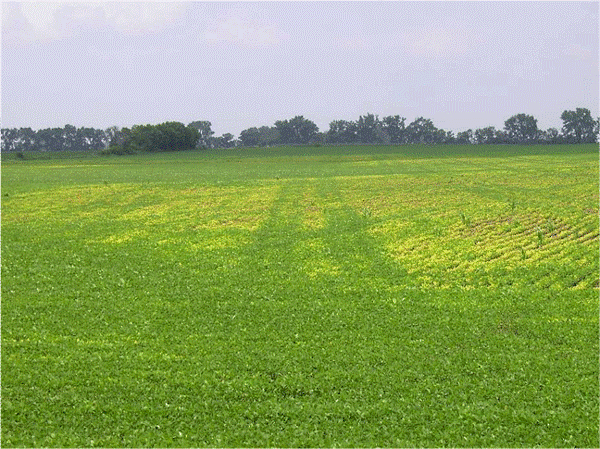
What causes this? The lighter plants are manganese deficient for sure but why the greener color for the compacted soil? The answer is simple. Driving over the soil compacts it. This pushes out the air and thus decreases the presence of oxygen. With less oxygen present the reducing organisms made more manganese available as Mn2+ while the surrounding area had more oxidized manganase (Mn4+) and shows deficiency symptoms.
The conclusion isn't that you need to drive all over your fields--rather there is a critical need to change the overall environment to favor the reducer organisms.
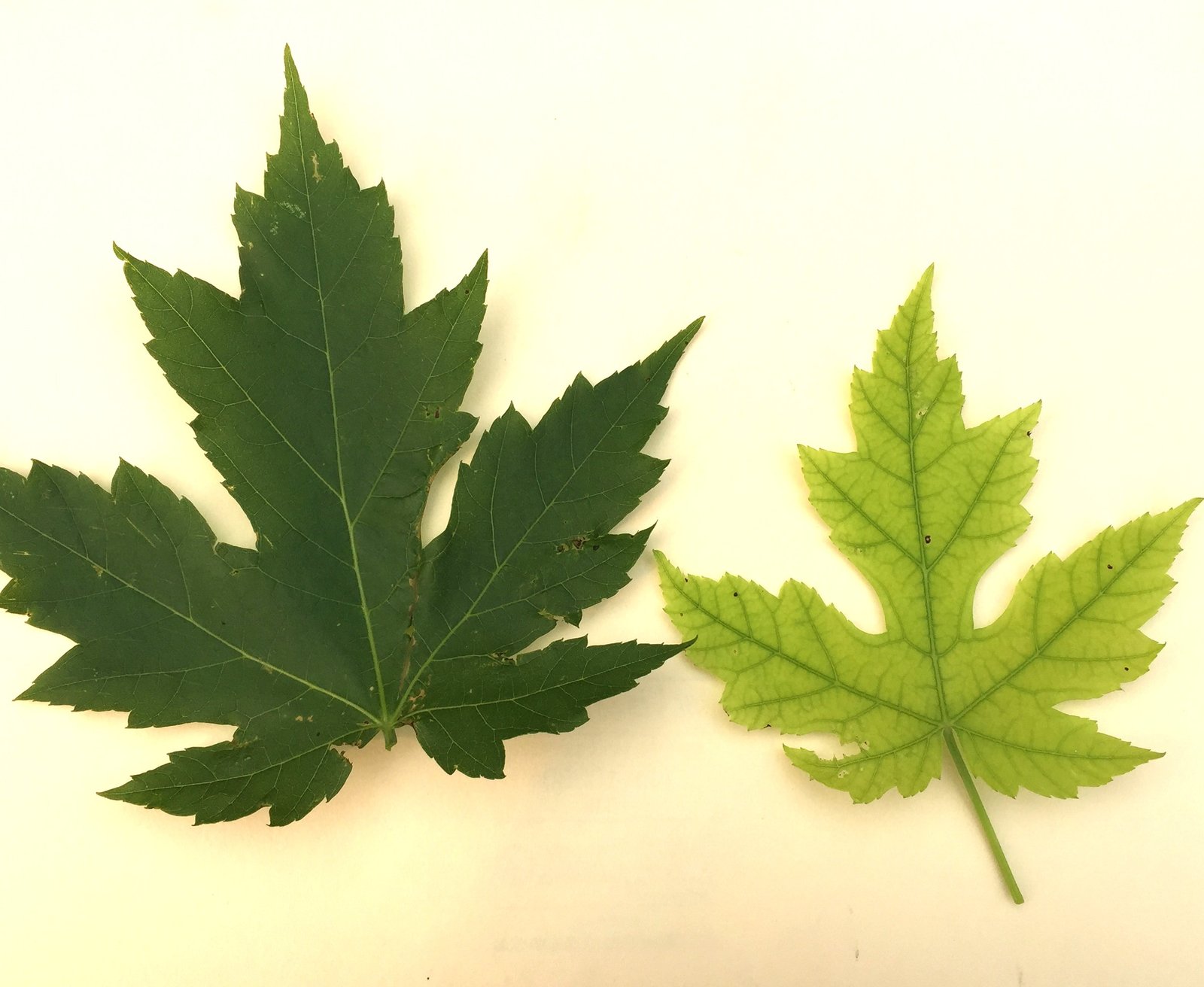
A manganese deficiency is recognized by interveinal chlorosis (yellowing between the veins of the leaves) while the veins themselves remain dark green. See the maple leaves for a visual comparison. With manganese deficiency comes an increased susceptibility to disease and reduced yield.
On a plant tissue 20 ppm or less on a dry matter basis is the blinking red zone. Get it up as fast as you can. The general goal is to get manganese to 100 ppm or a little higher.
Crops with a high manganese requirement include:
- Soybeans
- Wheat
- Barley
- Oats
- Nut Trees
- Stone Fruit Trees
- Watermelons
- Tomatoes
Corn has a medium requirement for manganese but still shoot for adequate levels in the tissue.
If you need to increase manganese in your plants right away the best approach is with a foliar program. I would strongly discourage the use of chelates or sulfates as foliars. These forms work best in the soil. Instead the nitrate forms have proven superior when properly formulated.
A suggested application for grain crops would be:
1 quart WayAhead 7X
2 lbs. Dextrose
Water as needed
For soybeans this should be combined with a quart of Bloomit to stimulate additional flowering and podset. For market gardeners, nut trees, and fruit trees replace WayAhead 7X to WayAhead 10X for increased calcium. If you have driplines include 4 oz. Manganese Chelate per acre periodically.
For gardeners mix and apply with a light misting:
1 quart Distilled Water
2 Tablespoons Dextrose
15 mills WayAhead 10X
To place an order please call MerriDee at 507-235-6909.
Lastly if you haven't signed up for my previous writing you may wish to. Both the Introduction to Biological Agriculture and the Gardening for Nutrition sequences have articles on foliar feeding.


